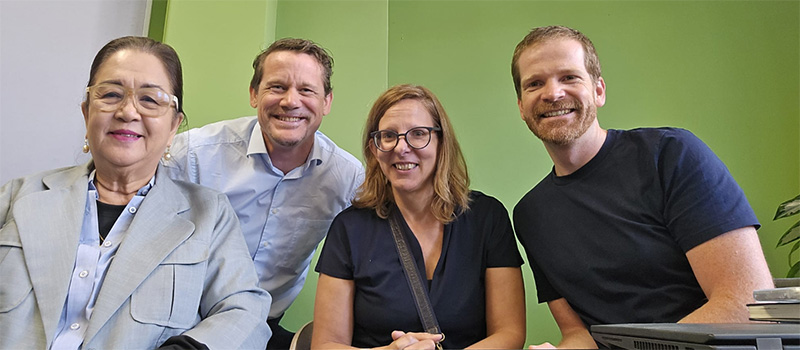
Left to right: Eva Ponce de Leon, Pascal Rudin, Eveline Amman Dula and Manuel Insberg
How can social work education and research contribute to a more sustainable, inclusive and globally connected profession? This question was at the heart of an exchange at the Bern University of Applied Sciences (BFH) on 11 September, bringing together IFSW Global President Eva Ponce de Leon and Interim Secretary-General Pascal Rudin with Prof Eveline Ammann Dula, Head of the Institute for Social and Cultural Diversity, and Dr Manuel Insberg, Research Associate and member of the department’s International Affairs team.
The meeting provided an opportunity to exchange perspectives on current research and teaching at BFH, explore possibilities for strengthening collaboration between social work education, research and the international profession, and consider how these areas connect with ongoing IFSW initiatives, including the promotion and implementation of the People’s Charter for a New Eco-Social World.
A central part of the discussion focused on Green Social Work and Eco-Social Work. Professor Ammann Dula outlined work she is undertaking together with Professor Swetha Rao Dhananka, IFSW Representative to the United Nations in Geneva, including a forthcoming publication. The discussion highlighted the growing importance of connecting environmental change, climate justice, health and social work practice.
This also led to an exchange on social work as a global profession and the ways in which international perspectives can be more strongly embedded in social work education. Both Professor Ammann Dula and Professor Rao Dhananka have contributed to IFSW’s handbook Social Work as a Global Profession, which brings together perspectives on the profession across different national and regional contexts.
Manuel Insberg presented his research on migration and refugees, with particular attention to the experiences of people living in collective accommodation centres. The discussion considered how conditions in collective accommodation affect refugees’ everyday lives, social participation and mental health, as well as the role social work can play in creating more supportive and inclusive environments.
Looking ahead, the participants identified several potential areas for collaboration. These included work around climate change and global health, strengthening the international dimension of social work education, and creating accessible opportunities for students and practitioners to engage with global social work.
Ideas included exploring closer cooperation with Schools of Social Work at the European level and developing accessible educational resources, such as short expert lectures or a virtual collection of resources on themes relevant to social work practice. The discussion also highlighted the importance of strengthening the visibility and accessibility of IFSW and its global resources through national member organisations, universities and their digital platforms.
Reflecting on the visit, IFSW President Eva Ponce de Leon said:
“Universities have a vital role in connecting research and education with the realities social workers and communities face around the world. Our exchange at BFH showed how much potential there is to bring students, educators, practitioners and the global profession closer together, particularly around emerging challenges such as climate change, health and migration.”
Professor Eveline Ammann Dula added:
“Social work increasingly needs to understand local challenges within their global context. Strengthening international exchange can help us develop the knowledge and perspectives that students and practitioners need to respond to social, environmental and cultural change.”
The visit marked a further step in strengthening connections between social work education, research and the international profession. The ideas explored at BFH provide a foundation for continued cooperation between BFH and IFSW, with the potential to create new opportunities for students, educators and practitioners to engage with and contribute to global social work.