Representatives from the International Federation of Social Workers (IFSW) United Nations Commission have joined regional leaders at the UN’s Asia-Pacific Forum on Sustainable Development 2026, raising urgent concerns that progress on the Sustainable Development Goals (SDGs) across the Asia-Pacific region is not only off track but, in several areas, regressing.

Convened by the United Nations Economic and Social Commission for Asia and the Pacific, the annual forum held every Februrary is the region’s key platform for reviewing SDG implementation and shaping global dialogue.
Throughout the discussions, a consistent message emerged: the region is facing a convergence of crises, including climate change, economic instability, and widening inequalities, that are undermining progress across multiple SDGs. For social workers, these trends reflect deeper structural gaps in how societies invest in people and communities.
Dr Cordoba emphasized that the current trajectory highlights the consequences of insufficient investment in social systems. “Across the region, we are seeing stagnation and regression in critical SDGs. This is not inevitable, it is the result of policy choices. We need urgent and sustained investment in social and care economies to reverse these trends,” he said.
The IFSW UN delegation underscored that social and care economies, including social protection, community services, and support systems, are foundational to achieving the SDGs. Yet, these areas remain consistently underfunded and undervalued in national and regional development strategies. Including the gendered dimensions of this issue, noting that care systems disproportionately impact women and marginalized communities.
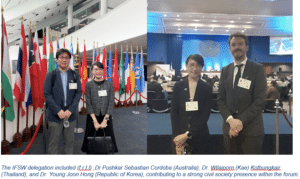
Dr Kotbungkair highlighted “As social workers, we must champion “development justice” by advocating for equitable access to resources, dignified work, and comprehensive social protection to ensure no one is left behind in the pursuit of the 2030 Sustainable Development Goals “
A central focus of the IFSW Centre’s engagement at APFSD13 was the role of civil society. Delegates from a wide variety of groups called for significantly greater inclusion of CSOs in decision-making processes, from policy design through to implementation and evaluation. Civil society brings critical expertise, local knowledge, and accountability mechanisms that are essential for effective and inclusive development.
Dr. Young Joon Hong emphasized “The stagnation of the SDGs across the Asia-Pacific underscores a critical gap in our social and care economies. My experience at this forum highlights that no nation is immune to these structural shifts. We must prioritize investment in the care economy not as a social cost, but as the essential foundation for a resilient and inclusive future that truly leaves no one behind.”
As the Asia-Pacific region prepares its contribution to the global SDG review process, the IFSW joins a growing number of voices calling for transformative change. “The evidence is clear, and the solutions are known,” Dr Cordoba said. “What is required now is the political will to invest in social and care economies and to work in genuine partnership with civil society.”
The IFSW team reaffirmed its commitment to advocating for these priorities at regional and global levels, ensuring that social work perspectives are included in shaping a more just and sustainable future.
The IFSW UN Global Commissioner, Priska Fleischlin adds: “Political decisions on global and national level are key for social work. IFSW influences global decisions by contributing to global discussion, so that national governments later, on national level, know the Social Workers position and are more likely to strengthen our profession on national level. On the other hand, global agreements can learn from the IFSW perspective. I would like to thank the three representatives, from three different member organizations of IFSW, volunteering to make IFSW visible at the UN.”