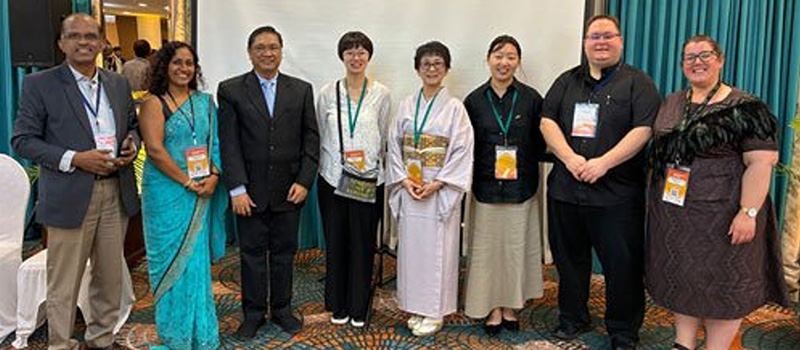
A report titled the Development of Standards for Social Work Education and Training in Asia and Pacific Countries: Examination for Global Education and Training based on the Global Standards is now available online from here (PDF). The report contains written versions of the presentations delivered at a similarly themed International Comparative Symposium held on November 19th, 2026 in Colombo, Sri Lanka during the 28th Asia Pacific Social Work Regional Conference (APSWC2025). The event also marked the launch of a related IFSW publication on Professional Social Work Education in the Asia Pacific Region: Development of Registration Systems for Qualification Holders, also available from below:
https://www.ifsw.org/product/books/professional-social-work-education-in-the-asia-pacific-region/
The symposium was co-hosted by the International Federation of Social Workers Asia-Pacific Region (IFSW-AP) together with the Japan College of Social Work (JCSW), and co-sponsored by the Asian and Pacific Association for Social Work Education (APASWE). The edited volume contains contributions from Aotearoa New Zealand, Japan, Korea, the Philippines, Sri Lanka, Taiwan, and India. Each report focuses on the current state and future of social work education in comparison with the Global Standards of Social Work Education and Training. The project relied on funding from the Social Work Research Institute (SWRI) at JCSW and the APASWE Co-Sponsorship scheme.
IFSW-AP President Machiko Ohara said of the report:
The development, evaluation, and application of educational standards grounded in global principles remain an essential task for ensuring the quality and relevance of social work education in an increasingly interconnected world. The Asia Pacific Region is distinguished by its exceptional diversity in historical trajectories, educational systems, social structures, and cultural contexts. Such diversity should not be regarded as a challenge to be resolved, but rather as a vital foundation for dialogue, mutual learning, and innovation in social work education.
The contributions in this report provide valuable insights into how social work education standards are being developed, interpreted, and implemented across different national and regional contexts, as well as how the Global Standards are being meaningfully adapted to local realities. It is our hope that this report serves not only as a platform for comparative analysis of current practices, but also as a catalyst for continued collaboration across the region. Through respectful dialogue and deeper understanding of our diverse pathways, we can further strengthen regional cooperation and enhance the networks that support the sustainable advancement of social work education in the Asia Pacific Region.
IFSW-AP Education Commissioner Mariko Kimura added:
The present conditions and future challenges of social work education in the Asia Pacific Region are highlighted in the report. We must emphasize that cultural heritage and historical backgrounds are influencing the factors that shape the condition and the direction of social work education in each context. The contributors agree that the Global Standards provide and reflect the present state of social work education around the world. We have learned about plural emphases that shape social work curriculum and the direction of professional social work in the Asia Pacific Region.
With global interaction, we look forward to further evaluations of social work education toward 2028, the 100th Anniversary Social Work Global Conference in Paris by IASSW, ICSW, and IFSW.
APASWE Secretary Jowima Ang-Reyes stated:
The changing social work landscape in the Asian and Pacific Region would create new creative paradigms to balance the new heights of co-creation significantly leading to new avenues for social and digital innovation. Moving forward, creating synergy would require one to look back in one’s history not as a deterrent but identifying the core strengths which lies within. Participating countries who have experienced foreign influences, are now seeing the value of giving premium to indigenized knowledge and traditions as a way to strengthen one’s social work practice in the region and even globally. One consolidated message of affirmation that being culturally inclusive would infuse one’s cultural heritage in to the equation of calibrating social work education and practice.
As we progress forward, timely discussions and continuous ways to bridge gaps that would lead to the vision of these considerations which addresses the significant changes caused by migration, peace and development, digitalization, climate change, human rights, the role of spirituality in social work practice, and other concerns. The pathway towards transformative social work education and practice with the guidance of the Global Standards providing a strong framework not to simply address the aftermath of the socio-political-economic-spiritual concerns, but to delve into the core issues that might have been systemic in nature that need to be reviewed and reinvented.
