Background and History
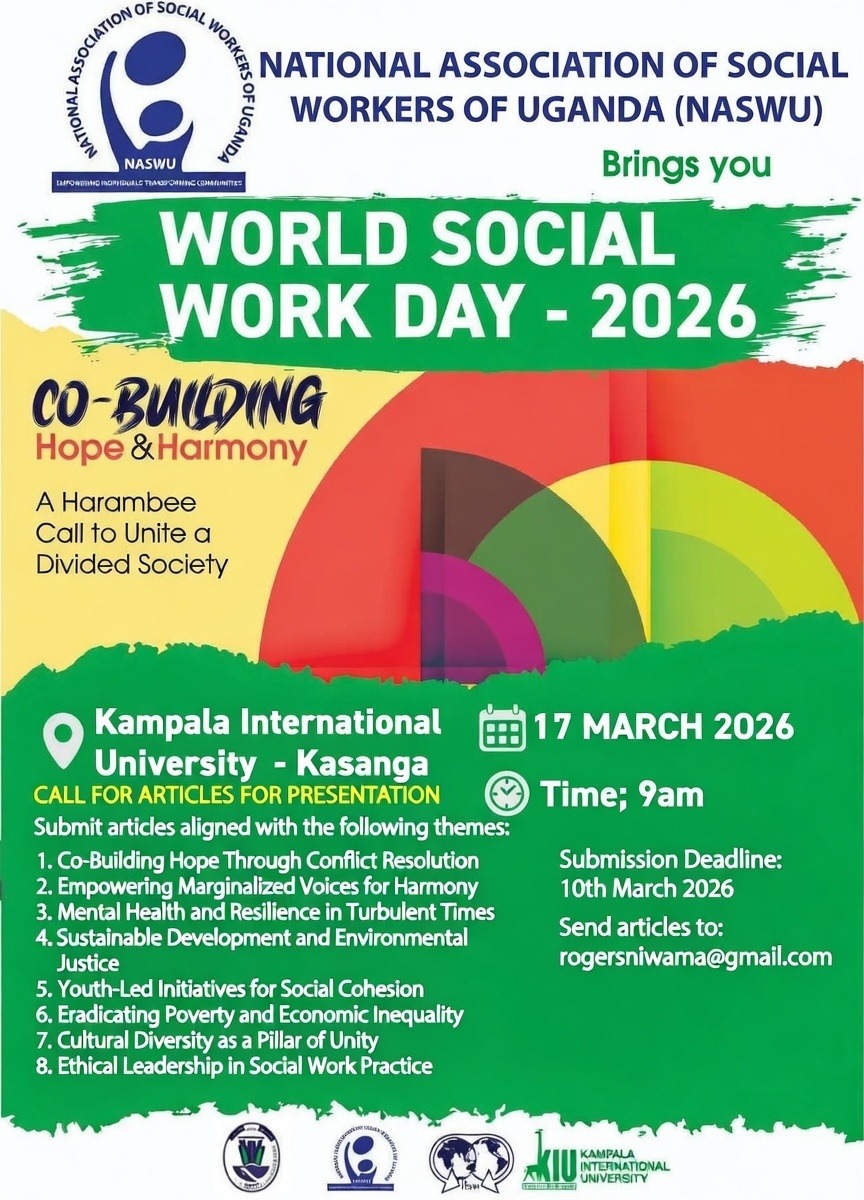
World Social Work Day will be celebrated on 17 March 2026. The theme for this year, ‘Co-Building Hope and Harmony: A Harambee Call to Unite a Divided Society’, highlights the vital role of social work in bringing people together across communities, cultures, and systems to shape a more inclusive and sustainable tomorrow.
The 2026 World Social Work Day theme, “Co-Building Hope and Harmony: A Harambee Call to Unite a Divided Society”, draws inspiration from the African philosophy of Harambee; a collective call for unity, mutual support, and shared responsibility. In a world increasingly fractured by conflict, inequality, displacement, and ecological crises, the theme is both a reminder and a challenge: that the only sustainable way forward is through cooperation, solidarity, and co-creation.
At its heart, social work is a profession rooted in the values of human dignity, social justice, and community participation. These values affirm that no society can thrive when its people are divided or excluded. The theme therefore underscores the urgent need to restore trust and to rebuild bonds of belonging in fractured communities. Social workers, together with their allies, are uniquely placed to nurture these processes standing with communities, amplifying marginalized voices, and facilitating dialogue across social, cultural, and political divides.
The choice of Harambee is deliberate and symbolic. Literally meaning “pulling together” or “all for one,” Harambee has long served as a rallying call in Kenya and across Africa, mobilising communities for self-help and collective development. Beyond its literal meaning, Harambee embodies the spirit of solidarity and shared responsibility, where every individual contributes what they can for the good of all. In this way, it resonates deeply with the African ethic of Ubuntu; “I am because we are” but with a practical emphasis on joint action and shared effort.
By invoking Harambee, the 2026 theme calls on social workers, governments, institutions, and communities worldwide to join hands in co-building spaces of hope and harmony. It challenges us to move beyond charity towards genuine solidarity, beyond service delivery towards systems change, and beyond divisions towards unity. It reminds us that peace is not merely the absence of violence, but the presence of justice, inclusion, and opportunity.
World Social Work Day 2026 is therefore a global call: to heal divisions, to strengthen resilience, and to shape a fairer and more sustainable future. It urges us to recognise that no single actor can overcome today’s challenges alone whether they be war, inequality, or ecological collapse. Hope and harmony are only possible when we “pull together,” across borders, sectors, and communities.
As a Kenyan proverb teaches us: “Sticks in a bundle are unbreakable.” In the same spirit, this theme affirms that when humanity unites in Harambee – pulling together as one, no adversity is too great to overcome, and no dream of justice, peace, and dignity is beyond reach.
Concept Overview
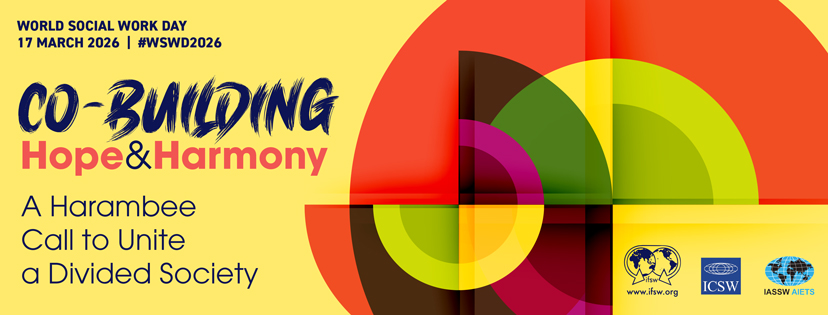
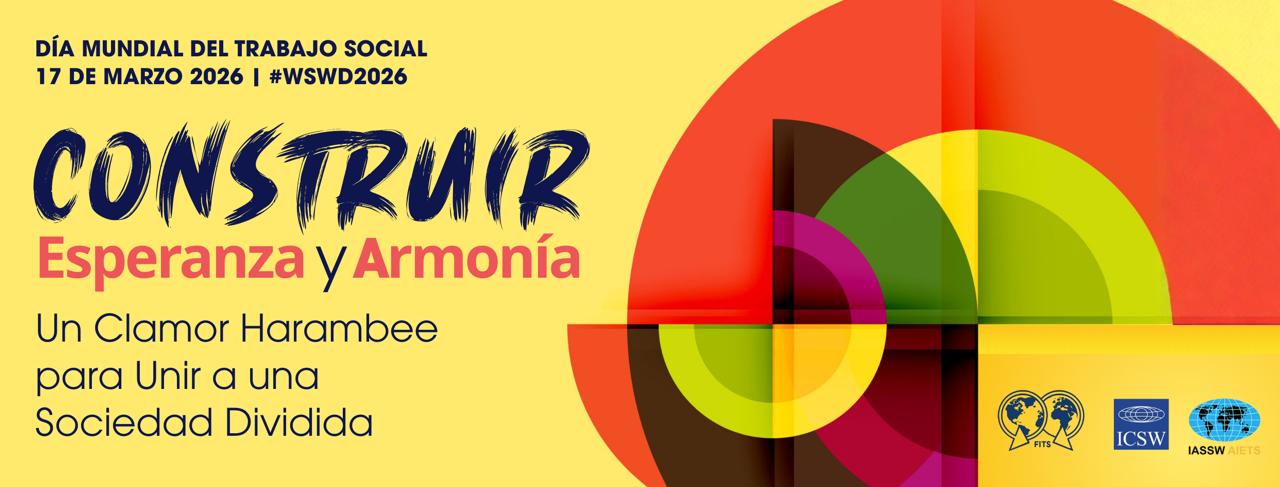
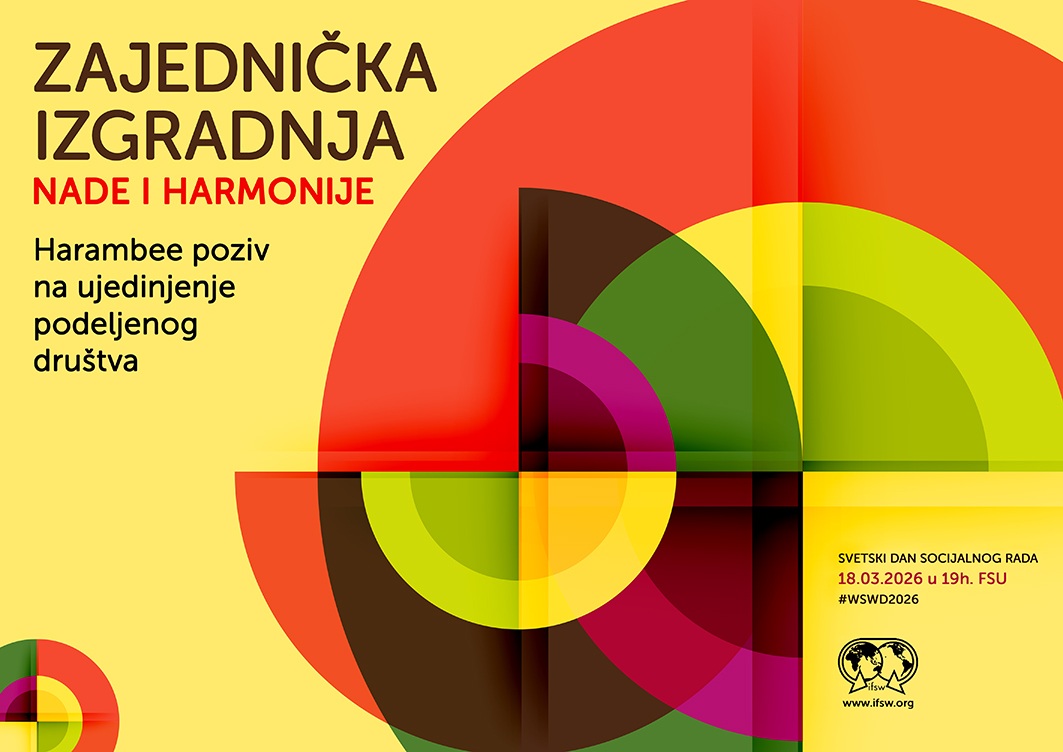
The 2026 World Social Work Day poster design visually interprets the theme “Co-Building Hope and Harmony: A Harambee Call to Unite a Divided Society.” The central idea of Harambee—a Swahili term meaning “pulling together” or “working together in unity”—is expressed through interconnected forms, harmonious color palettes, and typographic integration that reflects collective strength, community, and forward movement.
1. Visual Language
The poster design emphasizes connection, collaboration, and uplift:
- Interconnected shapes and lines symbolize individuals and communities coming together, forming a cohesive whole despite differences.
- Layering and overlapping elements represent unity built from diversity, where each part contributes to the larger vision of hope and harmony.
- Circular or radiating compositions echo the Harambee spirit of shared energy and collective momentum.
2. Color Palette
The chosen colors convey optimism, warmth, and inclusivity:
- Warm earth tones evoke community and humanity.
- Soft blues and greens communicate peace, balance, and healing.
- Accents of gold or coral suggest hope, light, and forward movement.
Together, the palette reflects both grounded compassion and aspirational unity — embodying the idea of co-building a more harmonious society.
3. Typography
Typography plays a key symbolic role:
- The bold, interwoven letterforms of “Co-Building Hope & Harmony” suggest collaboration and strength through shared purpose.
- Organic and rounded type treatments evoke approachability and connection, while clean modern layouts project clarity and inclusivity.
- Hierarchy and balance between the words “Co-Building” and “Harambee” visually reinforce the idea that progress happens through cooperation.
4. Composition and Layout
The poster compositions use balance and rhythm to mirror harmony:
- Alternating alignment and spacing create visual dialogue between elements — representing unity amid diversity.
- The placement of the date and hashtag (#WSWD2026) anchors the design, linking the theme to the global movement of social work solidarity.
- Whitespace is used purposefully to create breathing room and clarity, symbolizing openness and reflection.
5. Cultural Resonance
The inclusion of the word Harambee invites a cross-cultural interpretation rooted in collective action and social justice — principles central to social work. The design honors this call by integrating motifs that feel global yet grounded, avoiding regional clichés while expressing universal human connection.
Martha Rothblum, Designer
Joachim Mumba, IFSW President, stated: “Social workers are present in every corner of society, standing alongside communities as they navigate adversity. We walk with people as they rebuild bonds, restore trust and strengthen resilience. The call to co-build hope and harmony reminds us that no challenge is too great when we move forward together.This is the spirit of the People’s Charter for an Eco-Social World: an invitation to connect humanity through shared values, shared responsibility and shared hope. It urges us to work collectively for a world where dignity, participation, sustainability and peace form the foundation of our common future.”
A very special thank you goes to designer Martha Rothblum, whose creativity and commitment have shaped the visual identity of this year’s theme.
To learn more about the history of World Social Work Day, please click here.
Download, co-branding and translation
You may download the 2026 World Social Work Day poster by clicking one of the following links: English | Français | Español
For more translations and formats, please click below on ‘Poster Translations’ and ‘Other Formats’.
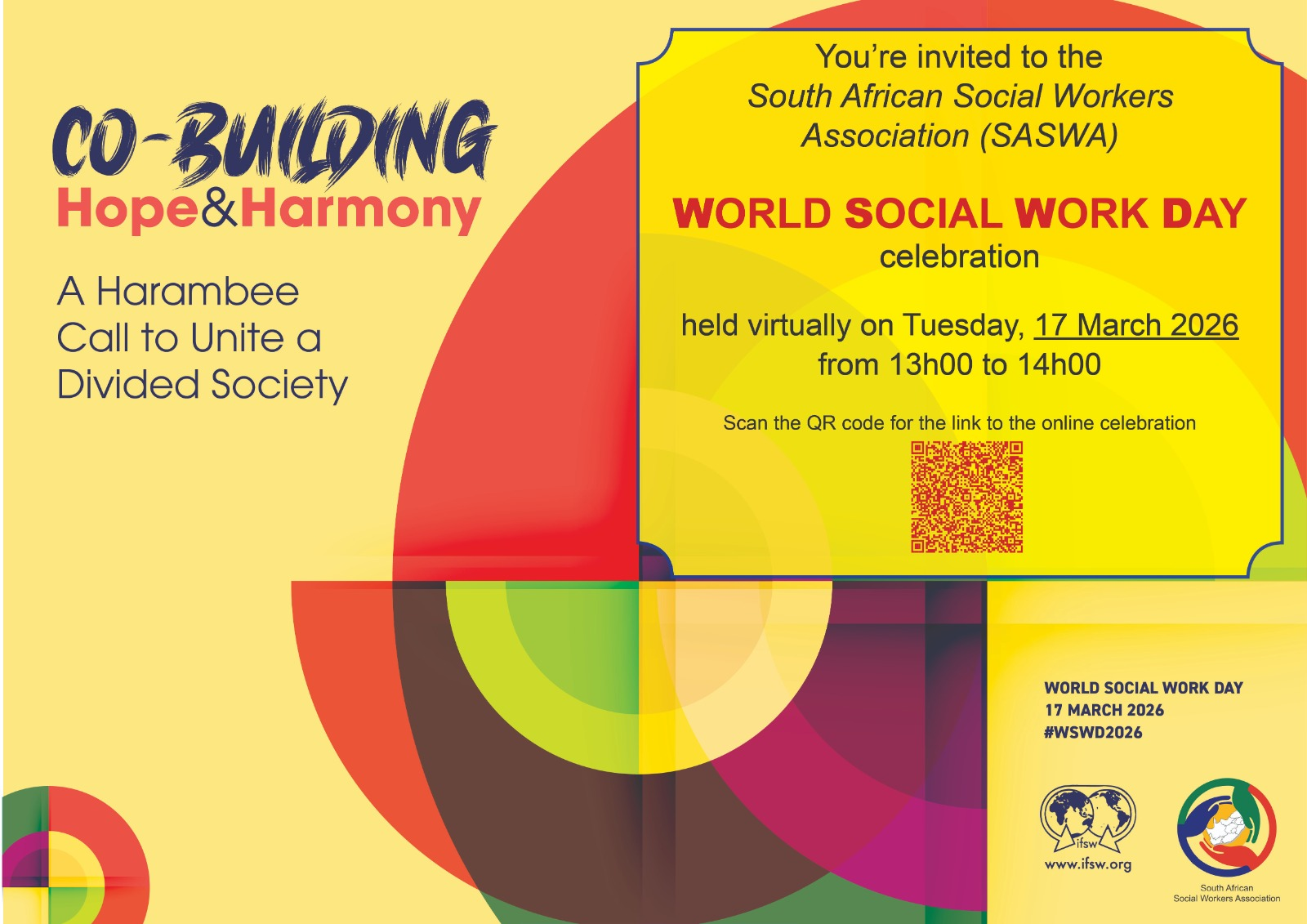
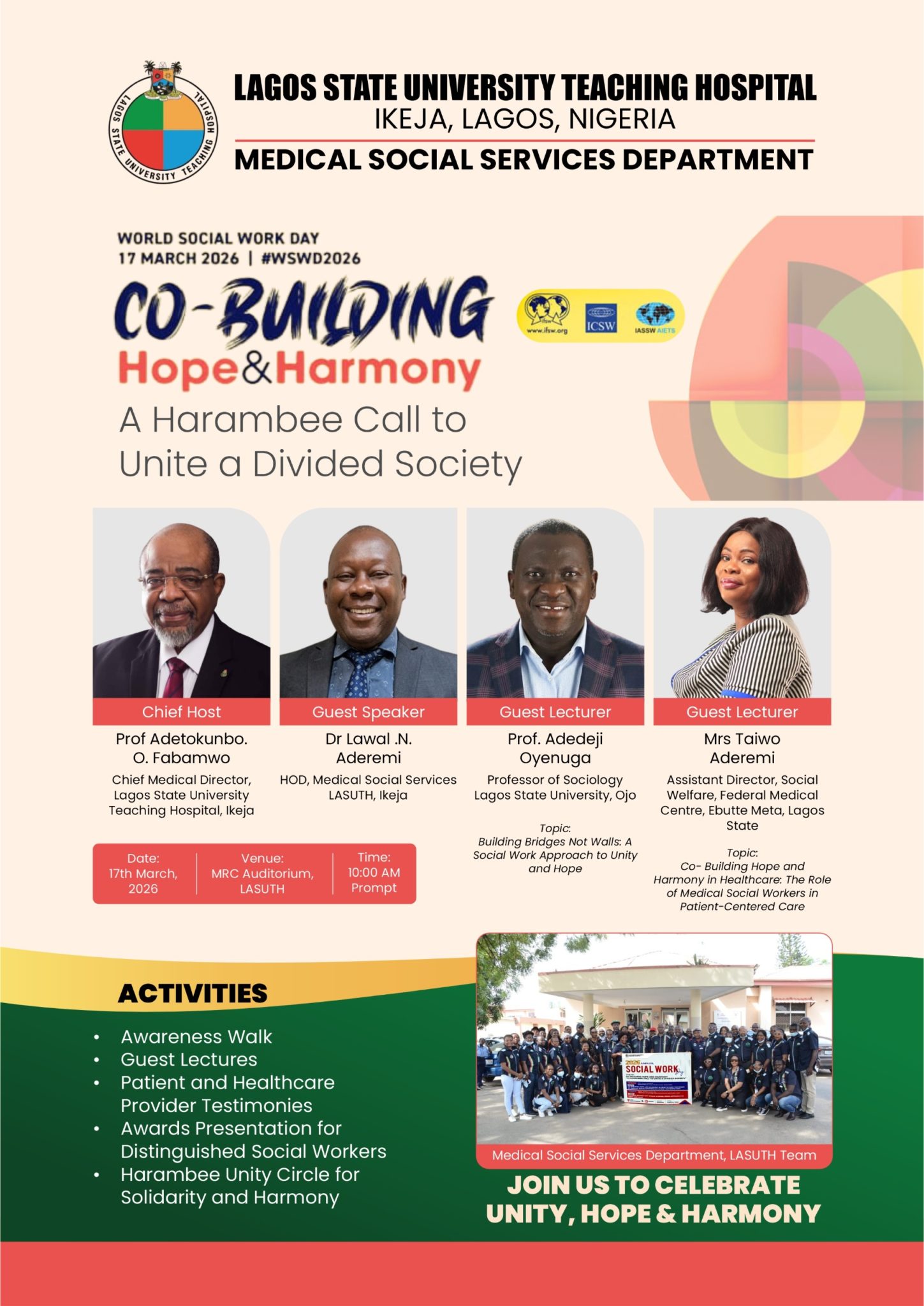
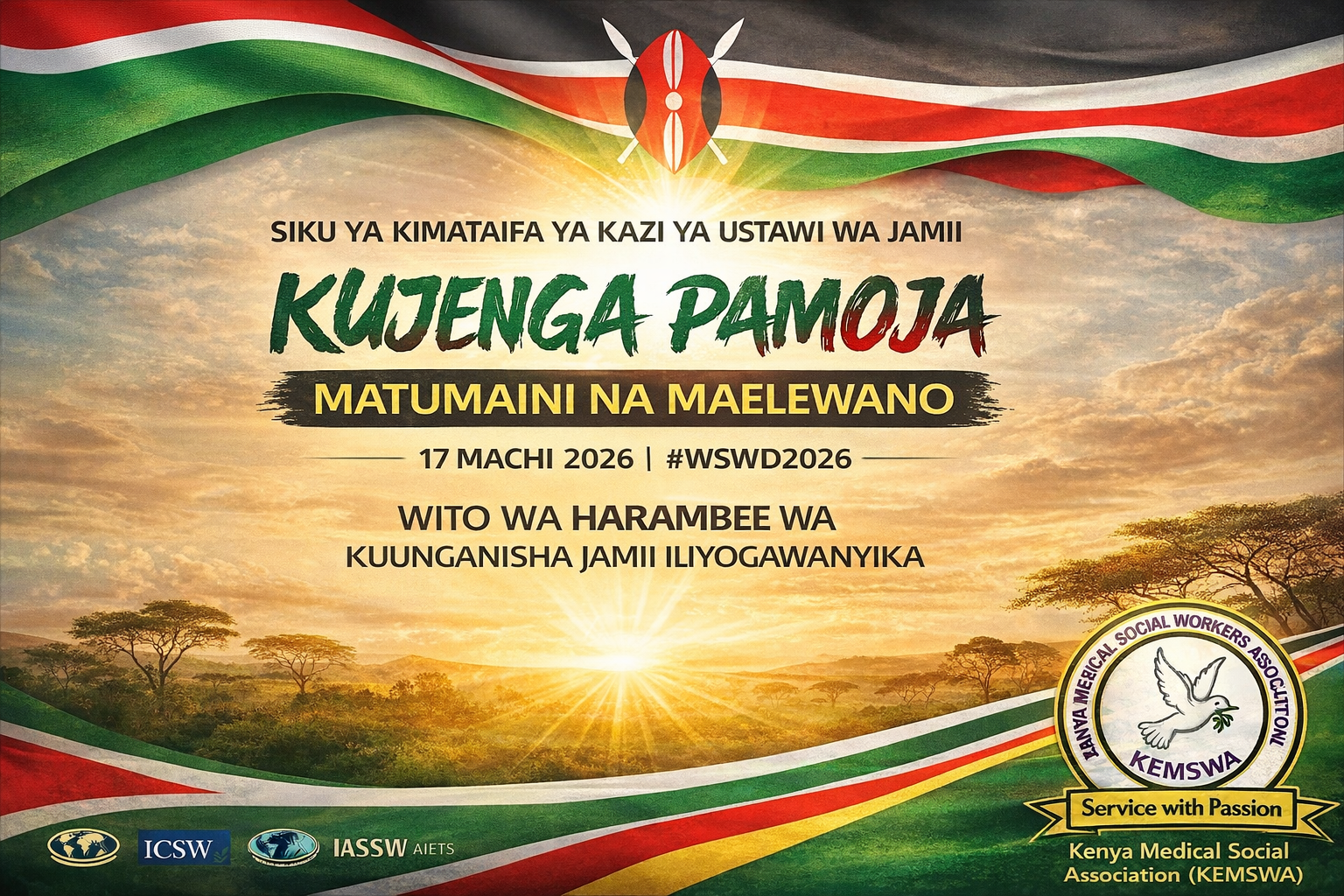
Co-branding the Poster: All networks, movements, and organisations that share the values of this poster are welcome to co-brand it by adding their logo alongside the IFSW logo. We also invite you to share with us your initiatives and plans for your #WSWD2026 event. We will upload information about your planned events on this page and distribute it among social workers around the world.
Translating the Poster: We will publish the translation of the World Work Day Poster into your language. Please click below on ‘Submit Translations’.
- Co-Building Hope and Harmony: A Harambee Call to Unite a Divided Society
- World Social Work Day
- 17 March 2026
Thank you all. IFSW will publish your translated poster on this page so that it can be shared across the world (please note that the relevant IFSW member organisation will be asked to approve the translation, which may take a few days).
Translations will be published here as they become available
Poster in Landscape Format
Social Media Banner Format: English | Spanish
Social Media Post Format
Videos will be posted here as they become available
Events will be posted as they are shared by members.
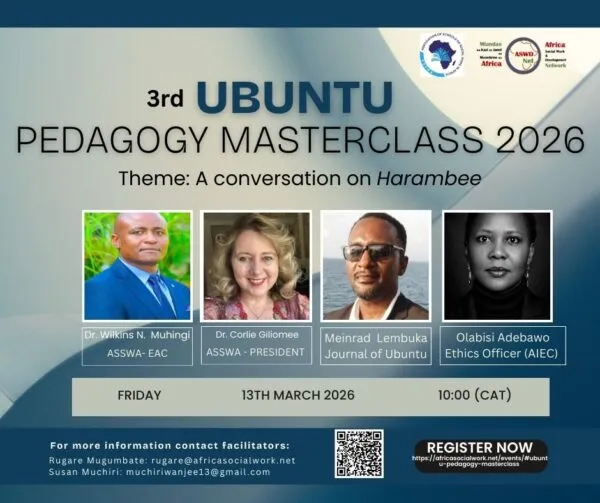
Panel discussion: “Students to Students: Contemporary Campaigns in Creating Social Cohesion.”

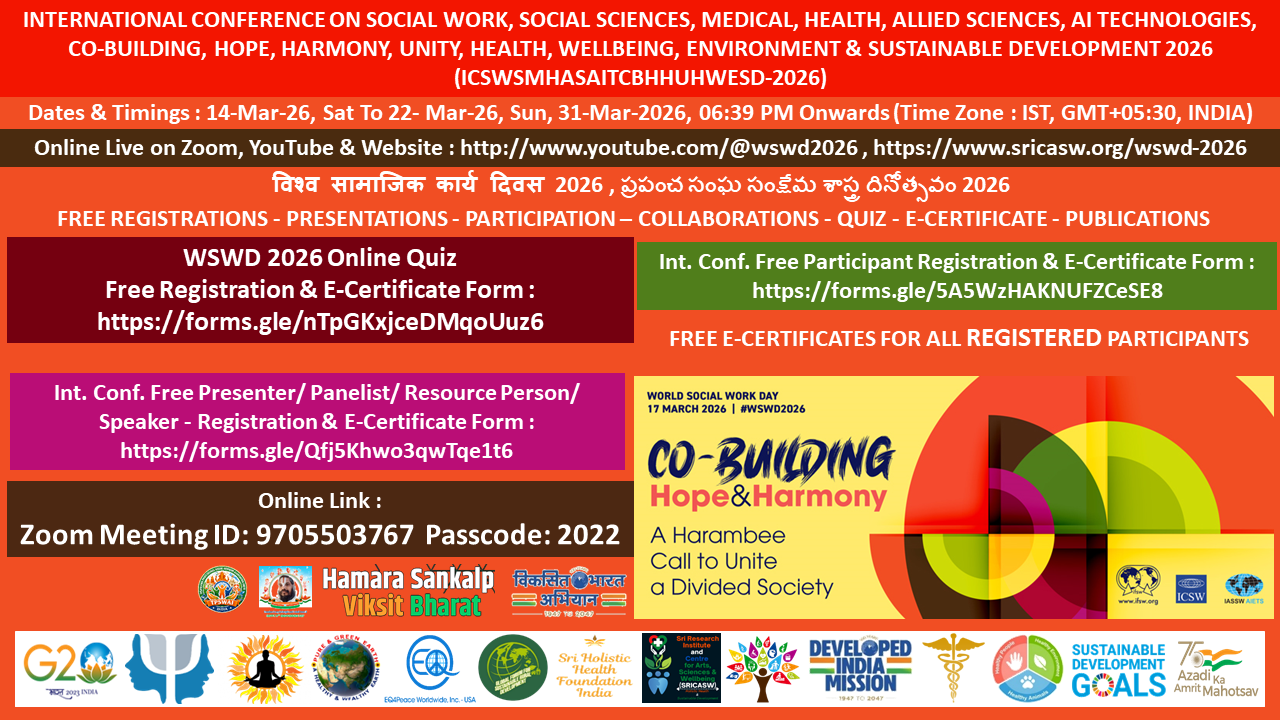
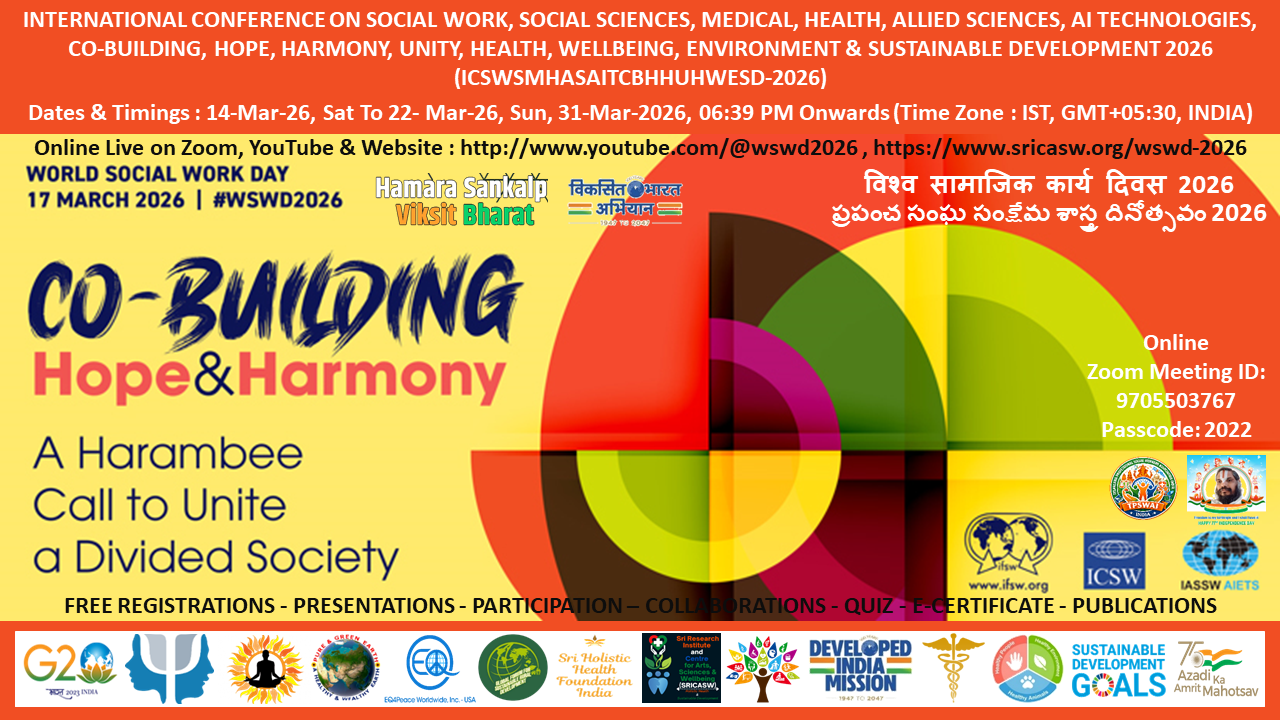
International Conference on Social Work, Social Sciences, Medical, Health, Allied Sciences, AI Technologies, Co-Building, Hope, Harmony, Unity, Health, Wellbeing, Environment & Sustainable Development 2026
(ICSWSMHASAITCBHHUHWESD-2026)
World Social Work Day, Week & Month 2026 International Celebrations & Commemorations – SHHFI & SRICASW
WSWD 2026 Theme : ‘ Co-Building Hope and Harmony: A Harambee Call to Unite a Divided Society ’.
SHHFI. SRICASW in collaboration with IFSW, TPSWAI, GFSRD, PEF, SNRCE, MFCT, International and National Fraternity, invites you all to join us online…
Dates & Timings : 14-Mar-2026 Saturday to 22- Mar-2026, Sunday, & 31-Mar-2026, Tuesday, 06:39 PM onwards (Time Zone : IST, GMT+05:30, INDIA)
WSWD 2026 Online Free Quiz Registration & E-Certificate Form : https://forms.gle/nTpGKxjceDMqoUuz6
Int. Conf. Free Participant Registration & E-Certificate Form : https://forms.gle/5A5WzHAKNUFZCeSE8
Int. Conf. Free Presenter/ Panelist/ Resource Person/ Speaker – Registration & E-Certificate Form : https://forms.gle/Qfj5Khwo3qwTqe1t6
WSWD 2026 & Int. Conf – Overall Feedback & E-Certificate Form : (In Zoom Session)
FREE E-CERTIFICATES FOR ALL REGISTERED PARTICIPANTS
Int. Conf. Online Platform: Zoom Meeting Joining Link : https://us06web.zoom.us/j/9705503767?pwd=Q1VKVGJOUG4vN1Y0MmNMQllKSk8wUT09 ,
Zoom Meeting ID: 970 550 3767 , Passcode: 2022
Int. Conf. YouTube Channel & Live Sessions : http://www.youtube.com/@wswd2026
Int. Conf. Website & E-Certificates Link : https://www.sricasw.org/wswd2026/worldsocialworkday2026 , https://www.sricasw.org/wswd-2026
Int. Conf. Presenters / Presentation Guidelines : https://www.sricasw.org/presentationguidelines2026
Int. Conf. Free Collaborations/co-signatories Registration : https://www.sricasw.org/collaboration
Int. Conf. Coordinator & Moderator : Sri./Dr. Ravindra R M , , +91 9705503767
Inviting Oral / PPT / Poster / Paper – Live& Pre-recorded Presentations, Workshops, Panelists/Panel Discussions, from Students, Scholars, Academicians, Practitioners of Social Work, Social Sciences & Other Allied Sciences & Technology Disciplines.
Inviting Free Collaborations from Social Work Schools, Departments, Colleges, Institutions, Universities, NGOs, Corporations, Associations from across the World. Be the part of the International Conference & Largest Daily Series of UN SDGs, AKAM@75, Viksit Bharat@2047 Celebrations & Commemorations.
FREE REGISTRATIONS – FREE NOMINATIONS – FREE AWARDS – FREE PRESENTATIONS – FREE PARTICIPATION – FREE E-CERTIFICATES – FREE ISSN/ISBN PUBLICATIONS (SELECTED) – FREE COLLABORATIONS for all.
PRESENTERS/PARTICIPANTS/COLLABORATORS FROM ACROSS THE WORLD, LEAVING NO ONE BEHIND…
No Collaboration Fees. No Registration Fees, No Publication Fees.
After Registration, Presenters are requested to send their Abstract/Full Paper/Summary & other documents to as per Presentation Guidelines for scheduling their presentations based on feasibility and availability of sessions on first come first serve basis.
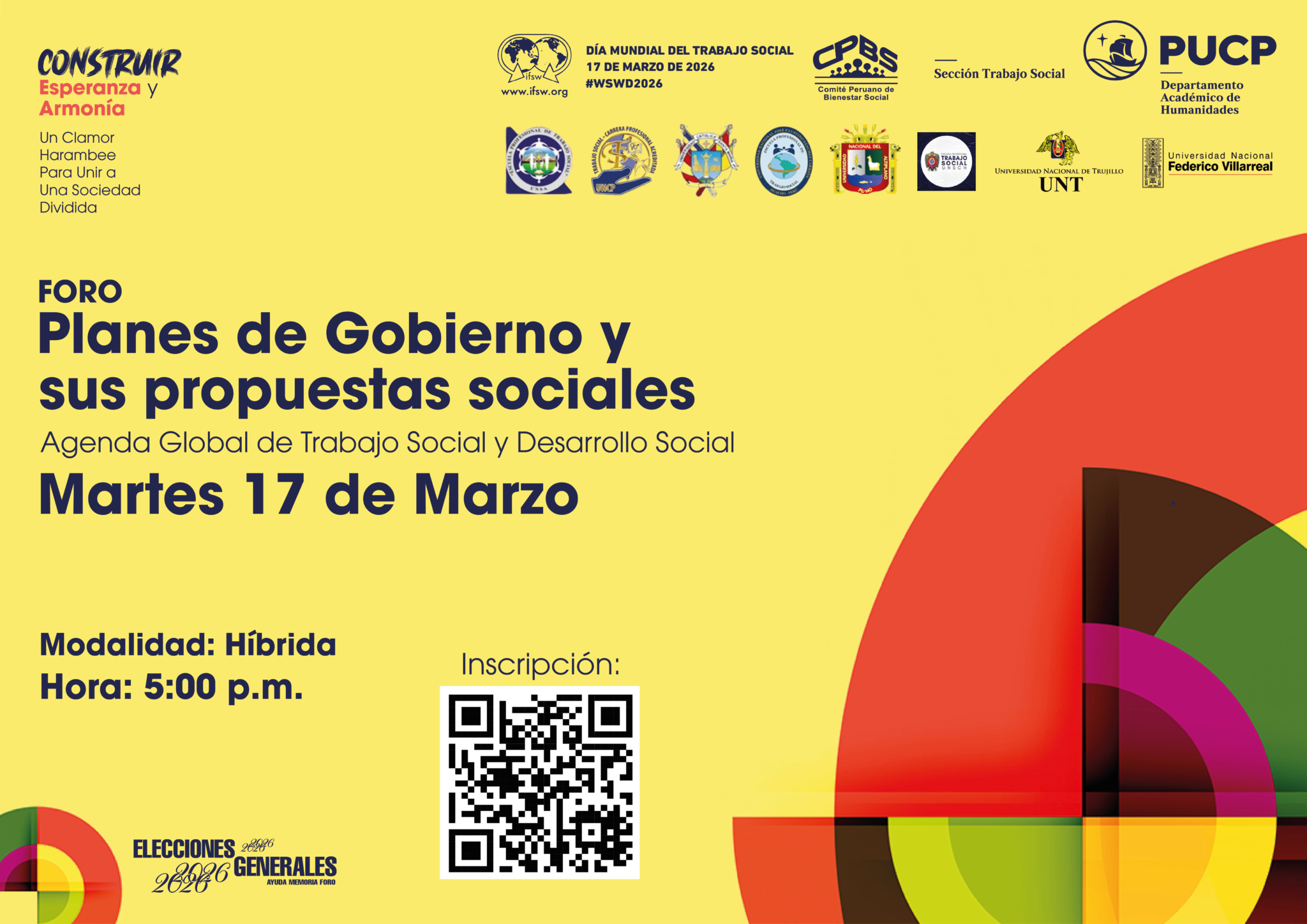
FORO
PLANES DE GOBIERNO Y SUS PROPUESTAS SOCIALES EN EL MARCO DE LA AGENDA GLOBAL DE TRABAJO SOCIAL Y DESARROLLO SOCIAL: ELECCIONES GENERALES 2026
Martes 17 de marzo, de 5:00 p.m. a 7:30 p.m. (Perú)
Formato Híbrido (virtual – presencial)
Presencial: Auditorio de Humanidades
Campus Pontificia Universidad Católica del Perú
Av. Universitaria 1801, San Miguel
1. Fundamentación
La formación académica y profesional en Trabajo Social cumplirá este 2026, 89 años de trayectoria en Perú y 101 años en América Latina y el Caribe, periodo durante el cual ha contribuido de manera sostenida al desarrollo social, al bienestar colectivo y a la promoción y defensa de los derechos humanos, especialmente en favor de los sectores históricamente excluidos y en situación de mayor vulnerabilidad social.
En la actualidad, América Latina y el Perú enfrentan crisis complejas y multidimensionales, expresadas en profundas desigualdades estructurales, múltiples formas de discriminación y exclusión socioeconómica y política, conflictos sociales, degradación ambiental, persistencia de la pobreza y una creciente crisis de los cuidados, con impactos diferenciados según género, edad, territorio y condición étnica, social y racial.
Por otro lado, a nivel mundial se conmemora este 17 de marzo el Día Mundial del Trabajo Social, con el tema “Co-construyendo esperanza y armonía: un llamado Harambee para unir una sociedad dividida”, inspirado en la filosofía africana Harambee, que convoca a la unidad, al apoyo mutuo y a la responsabilidad colectiva. Este enfoque pone en valor el rol estratégico del Trabajo Social en la articulación de actores, saberes y voluntades para la construcción de sociedades más justas, inclusivas y sostenibles, en consonancia con la Agenda Global de Trabajo Social y Desarrollo Social: Compromisos para la Acción.
Dicha Agenda constituye una plataforma internacional impulsada conjuntamente por la Asociación Internacional de Escuelas de Trabajo Social (IASSW), el Consejo Internacional de Bienestar Social (ICSW) y la Federación Internacional de Trabajadores Sociales (IFSW). Sus compromisos identifican cuatro campos prioritarios de acción a nivel global, nacional y comunitario:
– la promoción de la igualdad social y económica
– el fortalecimiento de la dignidad y el valor intrínseco de todas las personas
– el trabajo hacia la sostenibilidad ambiental
– el reconocimiento de la centralidad de las relaciones humanas para la cohesión y el bienestar social.
Considerando, además, el proceso electoral con motivo de las Elecciones Generales de abril de 2026 que se realizarán en Perú, resulta imperativo promover un análisis riguroso, plural y técnicamente fundamentado de las propuestas contenidas en los planes de gobierno de los partidos políticos. Este análisis debe poner especial énfasis en las políticas públicas y sociales; sistemas de protección social; pobreza y vulnerabilidad de grupos priorizados (niñas, niños, adolescentes, mujeres, personas adultas mayores, personas con discapacidad, población migrante y pueblos indígenas); así como en materia de salud, educación, empleo y derechos laborales, cambio climático y demográfico, justicia social y derechos humanos.
En este contexto, la Sección de Trabajo Social del Departamento Académico de Humanidades de la Pontificia Universidad Católica del Perú, la Facultad de Trabajo Social de la Universidad Nacional del Altiplano, la Facultad de Trabajo Social de la Universidad Nacional del Centro, la Escuela de Trabajo Social de la Universidad Nacional de Trujillo, la Escuela de Trabajo Social de la Universidad Católica Santa María de Arequipa, la Escuela de Trabajo Social de la Universidad Nacional San Agustín, la Escuela de Trabajo Social de la Universidad Nacional Faustino Sánchez Carrión, la Escuela de Trabajo Social de la Universidad Nacional Federico Villarreal y el Comité Peruano de Bienestar Social (COPEBISO), unen esfuerzos para organizar el Foro: “Planes de Gobierno y sus propuestas sociales en el marco de la Agenda Global de Trabajo Social y Desarrollo Social: Elecciones Generales 2026”, concebido como un espacio académico, plural y democrático de diálogo entre la profesión, la academia y actores políticos.
2. Objetivos
General:
Promover un espacio de análisis, diálogo y reflexión crítica sobre las propuestas sociales contenidas en los planes de gobierno de los partidos políticos participantes en las Elecciones Generales 2026, a la luz de los compromisos de la Agenda Global de Trabajo Social y Desarrollo Social y de los principales desafíos sociales del país.
Específicos:
– Analizar las propuestas de política social, protección social y desarrollo humano incluidas en los planes de gobierno desde un enfoque de derechos humanos, género, interseccionalidad y curso de vida.
– Contribuir al fortalecimiento del debate público informado y responsable, promoviendo la participación de la comunidad universitaria y de la ciudadanía interesada.
– Reafirmar el rol ético político y técnico del Trabajo Social en la vigilancia social, el análisis de políticas públicas, sociales y de protección, así como la promoción de sociedades más justas e inclusivas.
3. Público objetivo
Estudiantes universitarios, docentes, personal administrativo, integrantes de las escuelas de Trabajo Social de las universidades públicas y privadas del país, público interesado.
4. Formulario de inscripciones
https://forms.gle/5injTHhx19EZPCv98
5. Panelistas
Decanas y Directores de las Escuelas de Trabajo Social de las universidades públicas y privadas del país y del Comité Peruano de Bienestar Social.
6. Organizan
Sección de Trabajo Social del Departamento Académico de Humanidades de la Pontificia Universidad Católica del Perú, la Facultad de Trabajo Social de la Universidad Nacional del Altiplano, la Facultad de Trabajo Social de la Universidad Nacional del Centro, la Escuela de Trabajo Social de la Universidad Nacional de Trujillo, la Escuela de Trabajo Social de la Universidad Católica Santa María de Arequipa, la Escuela de Trabajo Social de la Universidad Nacional San Agustín, la Escuela de Trabajo Social de la Universidad Nacional Faustino Sánchez Carrión, la Escuela de Trabajo Social de la Universidad Nacional Federico Villarreal y el Comité Peruano de Bienestar Social (COPEBISO)