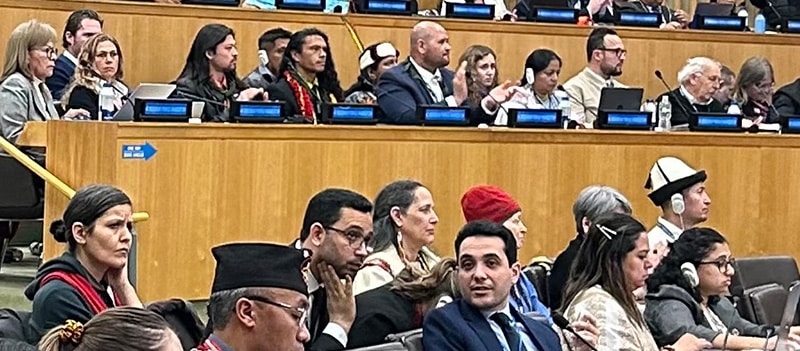
The 25th annual Permanent Forum on Indigenous Issues took place at the United Nations headquarters in New York City from April 20 through May 1, 2026. Global Commissioner Hilary Weaver and Regional European Commissioner Margaretha Karlberg Uttjek participated in the Forum. On behalf of the IFSW Indigenous Commission, the following statement was entered into the record of the United Nations Permanent Forum on Indigenous Issues under item 3, aligned with the theme of this year’s Forum, Ensuring Indigenous Peoples’ health, including in the context of conflict.
“Social workers’ roles in ensuring Indigenous Peoples’ health”
The International Federation of Social Workers (IFSW) is the worldwide body for professional social work. It comprises over 120 professional social work associations representing over 5 million social workers. We offer this statement as Indigenous social workers and members of the IFSW Indigenous Commission.
Social workers play key roles in ensuring Indigenous Peoples’ health. Our work is often done in collaboration with community members, activists, and other professionals. Social workers help Indigenous people access services and work to change unresponsive or harmful systems and policies.
For example, in Europe, Sámi social workers bring unique skills to their work drawing from inherited knowledges that can inform helping Sámi women and children experiencing violence, trauma, and various health issues. Likewise, Sámi Elders and Sámi living with various abilities have experienced misunderstandings and discrimination including marginalization and racism. This can lead to inadequate treatment from systems that should serve them, resulting in isolation and health issues.
In Latin America, health professionals must recognize traditional medicine’s role in treating addictions, emotional, mental, and physical conditions. Herbal practices in the Andean regions during the COVID-19 pandemic show how we continue to heal ourselves with our own medicines. Member States that ratified ILO Convention 169 on Indigenous and Tribal Peoples must ensure the effective implementation of its provisions on intercultural health, including incorporation of traditional healers.
In North America, creation stories and traditional knowledge systems inform Indigenous health. This knowledge heals our inner selves and restores our place in community following trauma that has disrupted our ways of living in balance. As social workers, when we embrace our own ways of being and knowing, we continue our focus on the person and their community; spiritually, physically, emotionally, and psychologically.
In the Pacific region, health is the vitality of the relational space connecting people, ancestors, and the environment. While social workers have at times caused harm as agents of colonial systems, Indigenous practitioners are reclaiming the profession, grounded in the teachings of our Wānanga (higher learning) in pursuit of holistic family wellbeing. Indigenous health interventions can be mana-enhancing acts of sovereignty. We can integrate traditional healing to soothe trauma that clinical models cannot reach.
When Indigenous social workers lead with ancestral knowledge, we don’t just treat symptoms; we restore the sacred connections essential for enduring peace and wellness. Indigenous social workers, grounded in our traditional understandings and teachings, as well as social work values of justice and human rights, are making a difference in the health and wellbeing of Indigenous Peoples around the world.