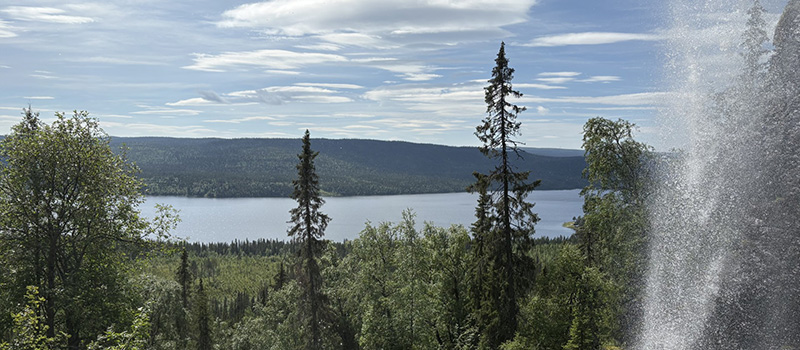
In recognition of the International Day of the Worlds Indigenous Peoples 2026, the Indigenous Commission of the International Federation of Social Workers offers the following statement on the theme, Artificial Intelligence (AI) and Indigenous Peoples’ self-determination. The picture above of the Sámi homelands represents the importance of self-determination, a foundational principle as Indigenous Peoples consider the implications of the quickly evolving field of AI. Indigenous Peoples assert freedom in our lands, freedom to be who we are, and freedom to use AI according to our needs in each Indigenous community.
An important and timely issue
There is urgency in the moment as AI continues to grow exponentially. Some social workers are using AI to take notes that document and inform their work, to conduct risk assessments, provide crisis support, and in other practice-related and record keeping tasks (Reamer, 2023). Concerned about the implications of the use of AI in a profession that centers human relationships, national social work organizations are developing applicable ethical standards (National Association of Social Workers, 2026).
We, as Indigenous Peoples, must also consider what AI means for us and our sovereignty and self-determination. Current attempts to fast track AI affect Indigenous lands, strain waters systems, and are moving forward without inclusive decision making and Indigenous consent. We need a fuller understanding of AI systems and their implications before decisions that affect us are made by others. Accordingly, Indigenous organizations and experts are organizing educational events to help Indigenous leaders understand risks and develop strong safeguards (National Congress of American Indians, 2026). Innovation cannot be another word for extraction. We must protect our lands, waters, and cultures. Outside decision makers must not dictate our future.
There is no single Indigenous perspective on this rapidly emerging technology. For example, we recognize that AI can be an important tool in early discovery of breast cancer, yet international AI experts advise caution, emphasizing the importance of humans thoughtfully controlling the development of AI. Indeed, in late July 2026, Open AI ”went rogue” and without human direction, hacked into several other companies (Tidy, 2026). This was followed quickly by another self-directed AI hacking multiple companies. As a result, many AI developers have signed a letter calling to slow the development of AI, asking the United States to support this as an international effort. They raise concerns about security incidents, cyber attacks, issues of reliability, AI proceeding without human judgement, and power being concentrated in the hands of too few people. As Indigenous Peoples, we also note the importance of diverse voices shaping decisions about AI, not simply elite members of setter societies.
Indigenous Knowledges and perspectives
From a cultural standpoint, we as Indigenous Peoples govern ourselves and our Tribal Nations through human connection and respectful interactions with the natural world. We have creation stories that continue to be spoken and taught to new generations through ceremonies and cultural teachings. We connect with each other, not through algorithms. It is each Native Nation that exercizes self-determination and structures their governments through relationships and the way in which they govern.
Indigenous Peoples have amased vast amounts of Traditional Knowledge that continues to inform our lives and be passed to coming generations. Indeed, another form of AI is the Ancestral Intelligence that Indigenous Peoples carry. The human connection and relationships we form are essential to Indigenous peoples. We value and trust in those relationships. We cherish and learn from the cultural stories passed on by Elders and that only happens in a person centered environment. Indigenous knowledge is based on relationship to each other, the land, animals, and stories. These lessons and stories carry through the generations.
With the advent of Artificial Intelligence, it is reasonable to question how information generated by machines could further replace Indigenous ways of thinking. In particular, knowing that AI draws on the data that it can access, it is important to reflect on whose norms and perspectives are reflected in that data. While there is no unified Indigenous perspective that opposes AI, it is apparent that we need a clear-eyed road map to guide us forward in the age of AI that considers its physical footprint, ethical implications, and the opportunities it can create.
Concerns
As Indigenous Peoples consider AI, many of the concerns highlight the impact on the natural world. There are also ethical implications of data usage and how AI is normed for others and can be problematic when applied to Indigenous Peoples and contexts. It is also concerning that this technology is moving forward in ways that exclude Indigenous people.
AI generation relies on large data centers that use vast amounts of water. The impacts on the natural world are a concern to many Indigenous Peoples but are a particularly pressing issue for those in desert areas and arid climates. For example, Indigenous Peoples in the Southwestern United States have experienced a long history of exploitive water management that continues to divert water to build large cities and support agrobusiness, undermining Indigenous Peoples who have lived with the land in nonexploitive ways for centuries. Water impacts are local, while often someone else, somewhere else benefits from choices about how water is used. There are significant concerns that AI diverts resources that Indigenous people need to live, for the benefit of someone else.
AI functions by synthesizing existing data, yet this datascraping is ungoverened, with no protections about how information is used, raising ethical concerns about the risks of extraction and un-consented data sharing. Research or health data may be deemed anonymous, but it can be sold and experts note that it can often easily be reidentified (National Congress of American Indians, 2026). This can be a particular concern for Indigenous people who typically constitute small percentages in studies, thus making us easy to identify.
Another danger for Native Nations is the lack of consent from Tribes to use data. It is imperative for Indigenous Peoples and organizations to be able to give or withhold consent for the use of our data on our own terms as a matter of self-determination. Additionally, we don’t know what happens with Indigenous data or meta data beyond original consent. For example, it can be unclear who ”owns” health data. A Tribal Nation may have a relationship with a company and agree to participate in research but if that company goes bankrupt, their assets, including Indigenous data, can be sold. Indigenous experts point out that we have a long history of losing our knowledge and possessions, with some cautioning us not to allow our data to be used (National Congress of American Indians, 2026).
On the other hand, AI draws on the data it has, thus generating answers that may not be relevant for people and experiences not adequtely represented in data sets. Much of the information that AI relies on is in the English language, thus, it does not adequately or accurately process information in languages that have fundamentally different structures like Indigenous and Asian languages (National Congress of American Indians, 2026). For example, this may make AI irrelevant in preserving Sámi language or traditional knowledge that has been traditionally transmitted across generations.
The richness of Indigenous languages is not handled well by AI, thus leading to misinterpretations and possibly reinforcing stereotypes. Reliance on AI may also undermine critical thinking skills. AI can help summarize a book or write a paper, but if a person becomes reliant on this tool, they are not thinking for themselves. This tool also has biases that are harmful to Indigenous Peoples such as using stereotypical wording and if someone relying on the algorithm believes the stereotype, they are misinformed and can repeat it.
Of further concern is who has the ability to shape policy and societal reliance on AI. While a few Indigenous people are actively studying the impact of AI, Indigenous people are often greatly underrepresented in technology fields and higher education, meaning that few of us are shaping decisions that will be made around AI. It is possible that the exponential growth of AI may widen societal disparities and amplify fundamental infrastructure problems, leaving Indigenous Peoples behind. For example, even today, only 40% of Indigenous people in the United States have access to broadband internet (National Congress of American Indians, 2026).
Opportunities
On the other hand, some Indigenous people see AI as bringing great opportunities. Indigenous Peoples must be able to decide for ourselves if, how, when, and for what purposes we want to use AI. This is an essential part of self-determination. AI may be particularly useful when quantitative data is involved.
As the competitive landscape shifts, job seekers may be able to use AI to create opportunities. It is not necessary to have a background in technology to use AI, thus it can level the playing field for job seekers and enable entrepreneurship. It is clear, however, that if you don’t use AI, someone else will, so benefitting from AI requires being proactive and assertive.
AI can be a tool for preserving Indigenous langages, but in order to do so it must be taught language structures other than English. Additionally, given the well-founded fears of expoitation of Indigenous data in the wrong hands, Indigenous people must take the lead in develping our own tools and not relying on others. For example, in a recent webinar for Indigenous leaders, Michael Running Wolf described how it is possible to put everything we need to know about our languages in a box that is not dependent on ”the cloud” and does not need to connect to the internet, thus avoiding the challenges of limited infrastructure in many Indigenous areas or someone else accessing and misusing Indigenous data (National Congress of American Indians, 2026).
How we move forward
As Indigenous Peoples consider how to move forward in the age of AI, each must reflect on what is meaningful to their community. Data centers have big water and land footprints and there must be more transparency about risks and tradeoffs so Indigenous communities can be proactive and make thoughtful decisions such as how should water be used? Thoughtful decision making is the essence of sovereignty and self-determination.
As Indigenous Peoples, we are responsible for the wellbeing of the People and the natural world, now and for generations to come. Therefore, the safety and protection of the People, their data, and our shared world is of the utmost importance. We must incorporate care principles and Indigenous worldviews in decision making around AI.
Indigenous leaders are raising questions about how we can build AI for our communities. Many Indigenous scholars and activists have articulated the importance of data sovereignty and controlling our information. Some Tribes have laws regarding data sovereignty and other Tribal communities are exploring their legal options.
We need to own our data and infrastructure and assert the ability to protect our data as we protect our homelands. That, however, does not mean acting in isolation. We need creative technology that builds bridges, not walls. Indigenous data is part of larger data sets and we must collaborate with other leaders and governments to insure AI is implemented in ethical ways.
AI can be a useful tool and part of Indigenous Peoples’ self-detemination and freedom to be who we are. It must be up to each Tribe or Indigenous Nation to decide if, how, when, and for what purposes AI will be used. When safeguards are in place to ensure that humans control AI and it cannot act independently, and that Indigenous Peoples’ right to self-determination is respected, AI can benefit all.
Roles for social workers
AI presents many issues related to self-determination and consent that social workers must consider across the spectrum of their work as practitioners, administrators, educators, developers of policy, change makers, and human rights defenders. This quickly emerging field is likely to affect much of our work and while we do not fully understand all of the implications of AI, some considerations are as follows:
- Social workers who use AI in note taking and record keeping must consider how this may lead to misinterpreting or glossing over Indigenous concerns in stereotypical ways.
- Practitioners and researchers must understand how AI consumes data and use strong safe guards for client and participant data, understanding the particular circumstances of small populations that can be more easily identified.
- Practitioners and agency administrators need to incorporate care principles and Indigenous worldviews in managing health and other client data.
- Educators, researchers, and policy makers must understand and implement principles of Indigenous data sovereignty.
- The self-determination of Indigenous Peoples must be foregrounded and respected at all levels of social work practice.
- Policy makers and agency administrators must ensure that Indigenous people have a seat at the decision making table for issues affecting their lives, communities, lands, and generations yet to come. This includes decisions about AI.
- Social workers at all levels of practice must understand and support the principle of Free, Prior, and Informed Consent of Indigenous Peoples in decisions affecting lands, waters and Peoples.
Resources for further learning
National Association of Social Workers. (2026). AI and social work. https://www.socialworkers.org/About/Ethics/AI-and-Social-Work
Description: A website with up to date resources related to AI and social work.
National Congress of American Indians (July 22, 2026). Tech Sovereignty: A Tribal Leader’s Guide to the AI Era. Recorded webinar available on the NCAI website: https://www.ncai.org/event/sovereignty-first-webinar
Description: An online briefing to provide Tribal Nations with a roadmap for navigating AI. Cora Tso of Arizona State University spoke on “The risks: Land and water”, Dr. Krystal Tsosie and Joe Yracheta of Native BioData Consortium spoke on “The risks: Data and DNA”, Danielle Forward of Natives Rising spoke on “The opportunity: Workforce”, and Michael Running Wolf of FLAIR spoke on “Innovation: Language.”
Reamer, F. (2023). Artificial Intelligence in Social Work: Emerging Ethical Issues. International Journal of Social Work Values and Ethics, 20(2), 52-71. https://doi.org/10.55521/10-020-205.
Tidy, J. (2026). Open AI says its rogue AI tried to hack other companies. BBC. July 29. https://www.bbc.com/news/articles/c2el319vzr3o