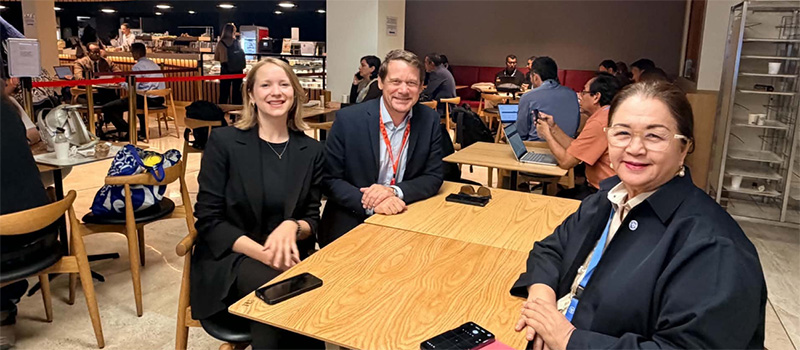
Left to right: Hannah Reinl, Pascal Rudin, Eva Ponce de Leon
Gender equality cannot be advanced in isolation from the other inequalities and experiences that shape people’s lives. Bringing this intersectional perspective into international advocacy, and connecting global commitments with action at regional, national and local levels was at the heart of discussions between IFSW and International Gender Champions (IGC) in Geneva on 16 September 2026.
IFSW Global President Eva Ponce de Leon and Interim Secretary-General Pascal Rudin, IFSW’s designated Gender Champion, met with Hannah Reinl, Project Manager at the International Gender Champions Secretariat, following IFSW’s recent joining of the network.
The discussion moved beyond a binary understanding of gender and emphasised the importance of recognising how gender intersects with age, disability, socioeconomic circumstances, migration, ethnicity and other dimensions of people’s identities and lived experiences. This intersectional approach has particular relevance to social work, where practitioners engage every day with people and communities experiencing overlapping forms of inequality, discrimination and exclusion.
The meeting also explored opportunities for IFSW to engage with the International Gender Champions Impact Groups, which bring organisations together around specific areas of action. Themes addressed by these groups include issues directly relevant to social work and the profession’s global agenda, such as climate change and digital technologies. They provide opportunities for IFSW to contribute social work knowledge, community perspectives and lived experience to international discussions that are shaping responses to some of today’s major social transformations.
A significant part of the discussion focused on taking this engagement beyond Geneva and the global institutional level. With member organisations across the world and established regional structures, IFSW can help connect the work of International Gender Champions with regional, national and local social work contexts.
This is envisaged not simply as a process of transmitting global commitments downwards. Experiences and knowledge from social workers, national associations and communities can equally travel upwards, helping to shape regional and international discussions. The meeting therefore explored how IFSW’s global network could create a two-way connection between international commitments and the realities experienced by people and communities.
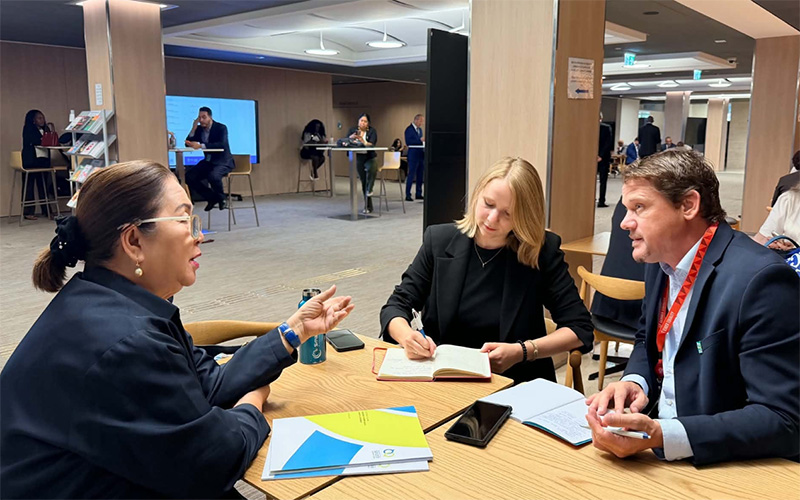
Discussions at the Palais des Nations, Geneva
Hannah Reinl, Project Manager at International Gender Champions, said:
“We are delighted to welcome IFSW to the International Gender Champions network. Social work brings an important perspective to our collective efforts, particularly through its understanding of intersectionality and its connections with communities around the world. Our discussion highlighted the potential to translate global commitments into action across regional, national and local levels, while ensuring that experiences from these levels also inform international conversations.”
IFSW’s participation in International Gender Champions is accompanied by concrete institutional commitments. By the end of 2027, the Federation will integrate an intersectional gender review into all new global policies, position statements and advocacy papers, making this a standard element of its policy development process.
IFSW will also apply the International Gender Champions Gender-Responsive Assemblies Toolkit to its 2028 General Meeting, identifying practical ways to strengthen gender responsiveness and inclusion within the Federation’s principal global decision-making forum.
In addition, IFSW has endorsed the International Gender Champions’ Panel Parity Pledge and Gender-Based Violence Pledge, reinforcing its commitment to inclusive participation, safe environments and addressing gender-based violence and sexism.
IFSW Global President Eva Ponce de Leon said:
“Social workers see every day how gender shapes people’s access to safety, opportunity, resources and participation. We also see the strength of individuals and communities challenging discrimination and creating change. Joining the International Gender Champions is an opportunity for our profession to stand alongside those efforts and to make sure that the voices and experiences of the people we work with remain at the heart of the pursuit of gender equality.”
Pascal Rudin, IFSW Interim Secretary-General, added:
“IFSW is entering a new era, and with that comes an opportunity to look critically at our own organisation, our practices and the spaces in which decisions are made. Being a Gender Champion is not simply about lending our voice to gender equality. It means embedding equality, inclusion and intersectionality into how we work, whom we listen to and how we exercise leadership. This is part of our responsibility as stewards of the profession: ensuring that the values we advocate internationally are also reflected within our own structures and practice.”
Established in Geneva in 2015, International Gender Champions brings together over 300 leaders from international organisations, governments, civil society and the private sector to advance gender equality through leadership, collaboration and measurable commitments. Its network extends across international hubs including Addis Ababa, Geneva, New York, Nairobi, Vienna, Paris and The Hague.
For IFSW, the engagement adds another dimension to its work for human rights and social justice: connecting international advocacy with the profession’s presence in communities around the world and ensuring that global commitments and local realities inform one another.