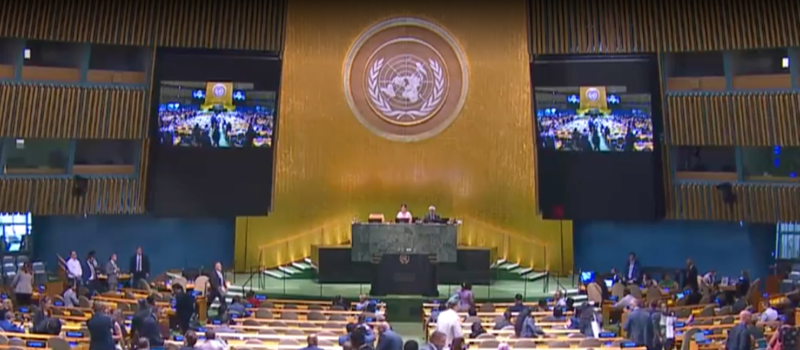
The International Federation of Social Workers (IFSW) has welcomed the United Nations General Assembly’s adoption of a landmark resolution endorsing the International Court of Justice’s (ICJ) advisory opinion on climate change, describing it as a defining moment for climate justice, human rights and global accountability.
The resolution, led by the Pacific Island nation of Vanuatu and adopted with overwhelming support by the General Assembly, reinforces that member states have binding obligations under international law to prevent climate harm, rapidly reduce greenhouse gas emissions, and protect communities most affected by the climate crisis.
The ICJ opinion clarified that governments may be in breach of international law where they fail to adequately regulate fossil fuel production, emissions, subsidies and other activities driving climate change. It further affirmed that climate action must align with the 1.5°C target under the Paris Agreement and prioritize protection for marginalized populations and future generations.
IFSW said the resolution reflects longstanding calls made by social workers at the United Nations and global climate forums for urgent, transparent, and accountable climate action grounded in social justice and human rights.
Priska Fleischlin, Global UN Commissioner for IFSW, said “This resolution is a powerful affirmation that climate action is not optional, it is a shared international responsibility. For communities already facing poverty, displacement, inequality, and environmental devastation, the climate crisis is an everyday reality. Social workers see firsthand how these intersecting crises affect people’s wellbeing, safety, livelihoods and futures. Governments must now act with urgency, accountability and partnership”
Sebastian Cordoba, IFSW UN Asia-Pacific Representative, said the decision highlighted the importance of collective global action and meaningful engagement with civil society and frontline communities.
“The Pacific region has shown extraordinary leadership in advancing climate justice despite contributing the least to global emissions, this moment demonstrates the power of grassroots advocacy, youth leadership, and international cooperation. We need immediate, transparent, and accountable climate action from Member States, alongside stronger partnerships with communities, Indigenous peoples, and civil society organisations working toward sustainable and inclusive futures.”
IFSW reiterated its support for a just transition away from fossil fuels and renewed calls for transformative eco-social change that addresses the interconnected nature of environmental, economic, and social crises.
The People’s Charter for an Eco-Social World is a key framework for co-building sustainable, peaceful, and equitable societies, alongside the IFSW policy paper The Role of Social Workers in Advancing a New Eco-Social World.
Climate justice cannot be separated from social justice. This is an opportunity for the international community to move beyond short-term interests and work collectively toward a just transition to systems that protect both people and the planet.