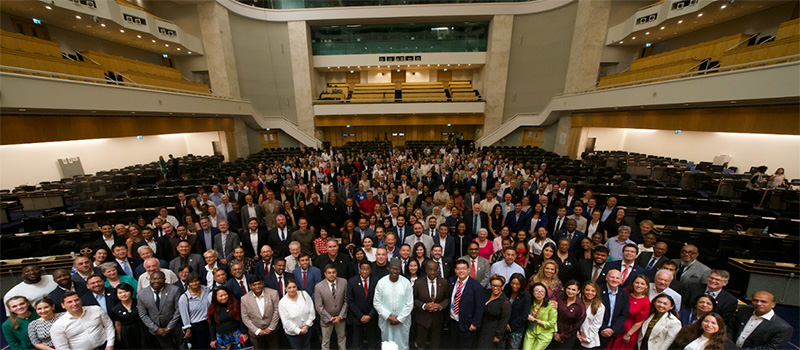
2026 AI for Developing Countries Forum Geneva Summit Participants, UN Assembly Hall, Geneva
The International Federation of Social Workers (IFSW) contributed to the 2026 AI for Developing Countries Forum Geneva Summit, held at the United Nations Office at Geneva from 12–14 August. The Forum brought together governments, international organisations, technology experts, researchers and civil society to consider a question that is rapidly becoming central to social and economic development: who will shape artificial intelligence (AI), and who will benefit from it?
For social work, this is not primarily a technological question. It is a question of human rights, social justice, power, participation and solidarity.
AI is already changing the environments in which people live and social workers practise. Increasingly, automated systems can influence access to information, education, employment, healthcare and social services. AI may create extraordinary opportunities to improve access to knowledge and services. But without deliberate action, it can also reproduce discrimination, concentrate power and deepen existing inequalities.
This concern was strongly reflected in the Forum’s manifesto, “Small Takes the Lead: The Future Belongs to the Many, Not the Few”. It warns of the concentration of knowledge, resources, wealth and power in a small number of technology companies, while much of humanity risks becoming primarily a source of data, labour and markets.
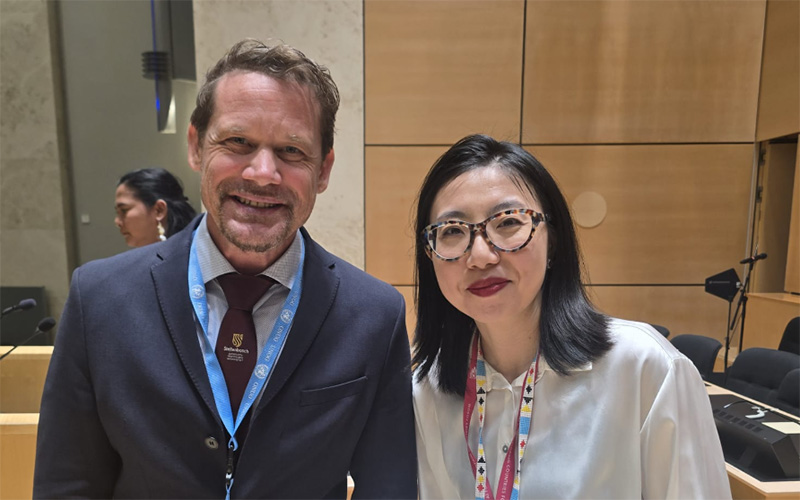
IFSW Interim Secretary-General Pascal Rudin with Velynne Ji, Co-founder and Director of the AI for Developing Countries Forum, who brings a lived perspective on the developmental impacts and technological needs of emerging global economies.
From a social work perspective, this raises a fundamental question: will AI strengthen people’s agency, dignity and participation, or will decisions affecting people’s lives increasingly be made through systems they neither understand nor control?
Preventing a new social divide
The Forum highlighted the importance of ensuring that countries and communities are not simply consumers of technologies developed elsewhere, but participants in designing and governing them. Its call for rebalancing envisages people and communities being able to co-build, own and govern the intelligence that shapes their lives, with AI serving the many rather than extracting from them for the benefit of the few.
This closely resonates with social work’s commitment to self-determination and the meaningful participation of people in decisions affecting their lives.
There is a particular risk that the existing divide between the majority world, home to most of the world’s population but with disproportionately less access to global resources and power, and the wealthier minority world will be replicated and intensified digitally.
Communities with fewer economic resources, limited digital infrastructure or languages poorly represented in existing AI systems may receive fewer benefits while carrying disproportionate risks.
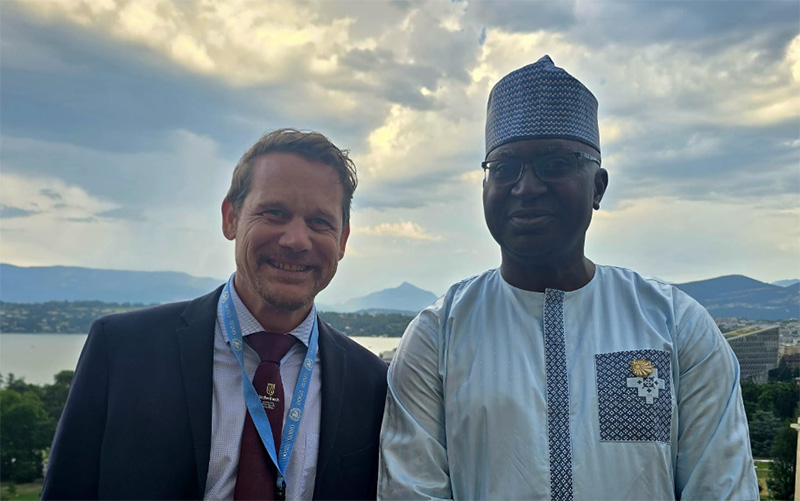
H.E. Prof. Muhammadou M.O. Kah, Ambassador of The Gambia, emphasising the importance of inclusive and equitable development in the age of AI.
Language is a striking example. The Forum noted that while more than 7,000 languages are spoken worldwide, fewer than 100 are well served by today’s AI systems. For social work, language is much more than a technical means of communication. It carries culture, identity, relationships, knowledge and ways of understanding the world. An AI system unable to recognise these dimensions risks excluding precisely those communities whose voices are already least represented.
Social workers need to be involved in how AI learns
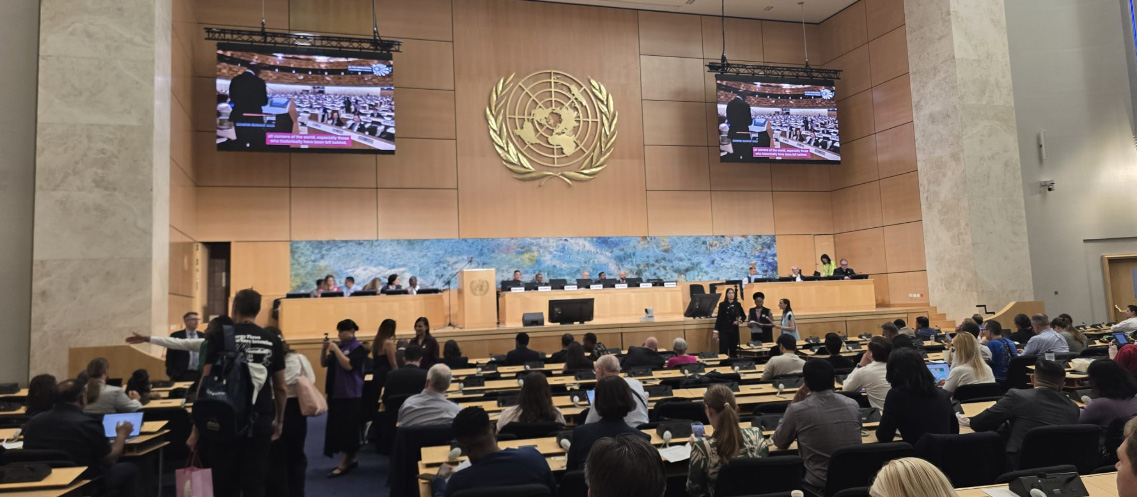
Participants at a main session of the 2026 AI for Developing Countries Forum Geneva Summit, exploring the opportunities and challenges of AI for global development.
The challenge goes beyond access to technology. Social work also has an important contribution to make to the ethics of how AI is trained, governed and used.
AI increasingly encounters people at moments of vulnerability. A young person may ask an AI system about suicide or self-harm. A family may seek advice during a crisis. Someone experiencing violence may turn to a chatbot before approaching a professional service. Governments and organisations may use automated systems to assess needs, allocate resources or identify risk.
These are not merely questions of computing. They involve safeguarding, relationships, culture, ethics, discrimination, human behaviour and human rights, areas in which social work has extensive knowledge and practice experience.
The profession therefore needs to be present not only when the consequences of new technologies become visible, but upstream, where AI systems, ethical standards and governance frameworks are being designed.
The Forum’s emphasis that governance should enable trustworthy, durable and just innovation is particularly relevant. Social work can contribute a perspective that asks not simply can this technology be developed?, but whose interests does it serve, whose knowledge does it contain, who might be excluded, and what happens when it gets things wrong?
Bringing a social work voice into the AI debate
Representing IFSW at the Forum, Interim Secretary-General Pascal Rudin contributed to panel discussions on digital infrastructure, education and corporate responsibility, bringing a social work voice to debates about the social and ethical implications of AI. Bridging engineering and social work perspectives, he highlighted the importance of connecting technological innovation with questions of human rights, social justice, relationships and the lived realities of people and communities.
Reflecting on the exchanges in Geneva, Rudin noted how conversations moved across issues as diverse as culture and health, suicide prevention, and trust between young people and institutions, revealing a common thread: the questions raised by AI are fundamentally social as well as technological.
“Our task is not to resist technology. It is to help ensure that technology strengthens human relationships, dignity and solidarity rather than replacing them; that it expands people’s opportunities rather than creating new forms of exclusion; and that the benefits of AI are shared across the majority and minority worlds. Social work has something important to contribute to that future, and we need to be at the table while it is being shaped,” Rudin added.
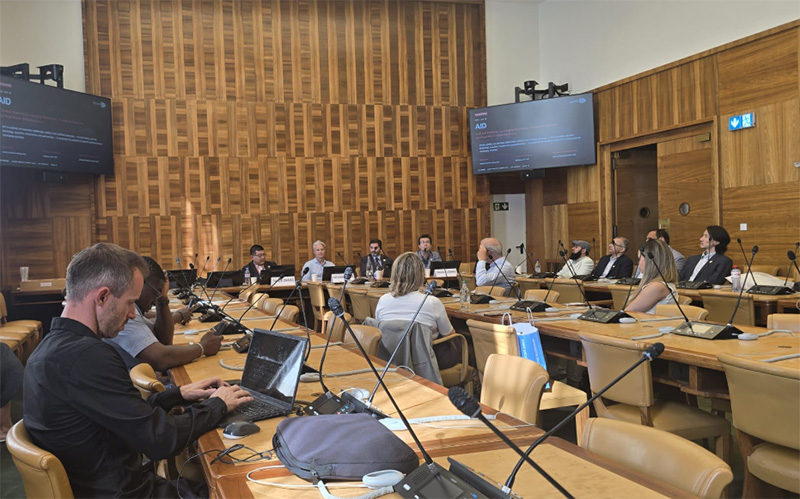
Panel discussions brought together diverse perspectives on the opportunities and social implications of AI
IFSW Global President Eva Ponce de Leon emphasised that engagement with AI needs to become part of the profession’s wider commitment to social justice:
“AI is rapidly becoming part of the environments in which people live, learn, work and seek support. Social work has a critical role in shaping that future. Our responsibility is to ensure that technological development strengthens human rights, social justice and solidarity, and that communities everywhere are participants in this transformation rather than being left behind.”
The Forum concluded with a powerful emphasis on plurality and distributed power: small should not be understood as weakness, but as a principle of humility and diversity, with the future belonging to the many rather than the few. This theme also ran through the Forum’s consideration of small enterprises, small nations, small models and small language models.
AI will continue to transform societies and social services. The question for social work is therefore no longer whether the profession should engage with AI, but how it can help shape its development in accordance with human rights, social justice, collective responsibility and respect for diversity.