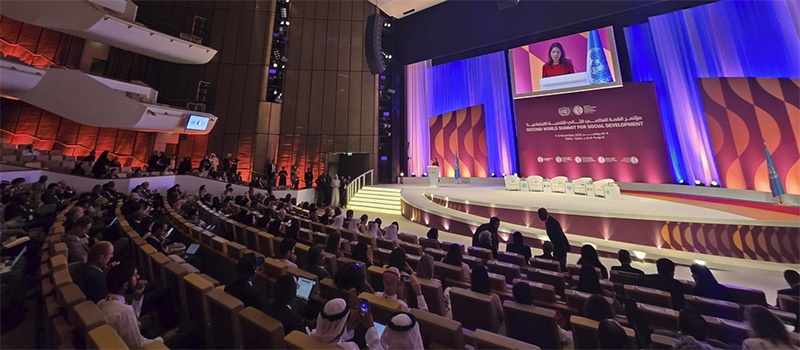
Image: Delegates attending the Second World Summit for Social Development in Doha, Qatar
Social workers increasingly have opportunities to shape international policies that affect the lives of millions of people. A new open access article by IFSW Interim Secretary-General Pascal Rudin explores how that role has evolved over the past three decades and what it means for the future of the profession.
Published in Social Work/Maatskaplike Werk, “From Copenhagen to Doha: A Critical Reflection on the Reconfiguring of Social Development, Knowledge and Authority through Global Social Work” traces the changing landscape of global social development between the 1995 World Summit for Social Development in Copenhagen and the Second World Summit, held in Doha in 2025, where IFSW was present with a delegation.
The article shows how global policymaking has changed. Rather than being shaped by governments alone, social development is now influenced by governments, UN agencies, civil society organisations and professional bodies working together. This has created new opportunities for social workers to bring practice experience, community knowledge and human rights perspectives into international decision-making.
A key focus of the article is the collaboration between the four global social work and social development organisations at the Doha Summit. IFSW, the International Association of Schools of Social Work (IASSW), the International Council on Social Welfare (ICSW) and the International Consortium for Social Development (ICSD) jointly organised three solution sessions on intergenerational solidarity, integrated social policies and universal social protection, and delivered a shared intervention during the Summit’s formal roundtables. The article discusses this collaboration as an example of how the profession can strengthen its voice through partnership.
At the same time, the article argues that greater influence also brings greater responsibility. As social work becomes more visible in global policy, it is essential that international organisations continue to reflect the diversity of the profession by ensuring that grassroots voices, regional experiences and perspectives from the Global South help shape international agendas.
IFSW President Eva Ponce de Leon welcomed the publication:
“This reflection captures something important about where our profession stands in the world today. Social workers are no longer waiting at the edges of global policy; we are helping to shape the conversation, bringing the realities of the communities we serve into the rooms where decisions are made. But visibility is not the same as influence, and the article reminds us that our task is to keep the values of social justice, human rights and human dignity at the centre, not merely to have a seat at the table. That is the work ahead, and it is work we take on together with our partners around the world..”
Read the article in full: https://socialwork.journals.ac.za/pub/article/view/1833